
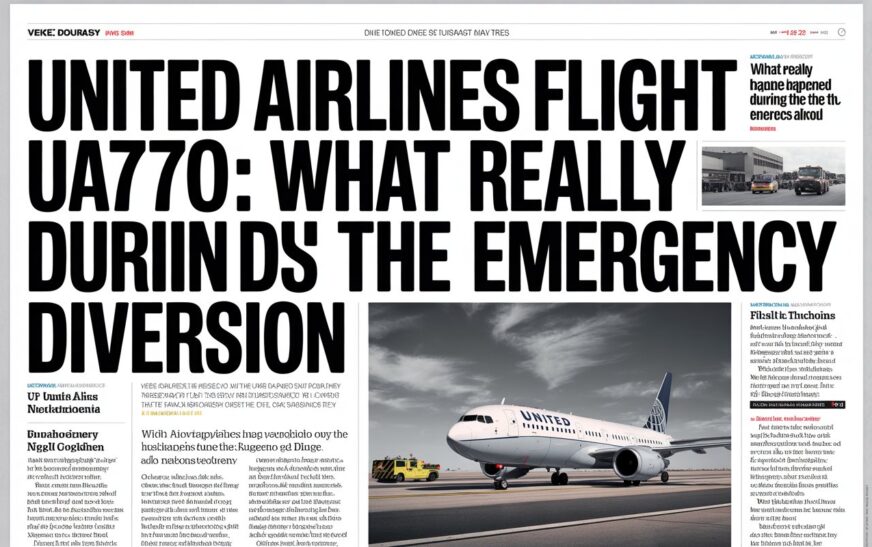
When an emergency is reported on a transatlantic flight, the news outlets and social networks become overwhelmed with conjecture. One of the stories became United Airlines Flight UA770, an aircraft of Boeing 787 series that operated a long-haul flight, and diverted the route, saying that a general emergency happened. This was followed by an archetypal aviation risk management situation: a rapid diversion decision, ground coordinated assistance and a successful safe resolution in the end. The following is one of the best professional reports of what took place, why it is important and what passengers should learn.
The sequence of events
Flight crew monitoring systems revealed that there was a possible system anomaly in UA770 that was on a routine long-haul flight and flying high above the international airspace. Taking into consideration the nature of the alert and the distance the plane has to its destination, the captain applied the usual operating procedures and declared an emergency to the air traffic control which is the official method of prioritising the flight and getting instant vectors with the nearest suitable diversion airport. After that the plane turned off course to London heathrow where the emergency services and the maintenance teams awaited the plane.
The airport and airline crews came to the aid of the passengers during the touchdown because they checked the airplane. No injuries were reported and the airline did rebook and secure accommodation to the travelers whose itineraries were affected on. The plane breakage is a stress experience to the passengers, but the trained crew interventioned in time and the safety nets that are developed in the existing aviation systems ensured that a minor issue did not escalate to major event.
What prompted the diversion?
The anomaly shown by the premature reports and the technical briefs are linked to the environmental control or pressurization system of the aircraft. Cabin pressure systems are sensitive ones: they are the systems that guarantee the presence of the breathable air at the altitude and any warning signal is to be not ignored. The response of crew in this case was based on system indications, protocols rather than waiting until it was confirmed that the warning was false indications. The aviation law says it all – in as far as there is even the slightest chance of any life sustaining system to be compromised then the appropriate and safe action that should be taken is diversion to the closest fitting airport.
It is also important to note that much of the alerts in the modern aircraft is preventive. The automated monitors and sensors are specially sensitive to allow them to indicate the conditions at an early stage. A warning that has been issued does not mean that there must be disastrous failure, it just means that the situation must be approached as one that can be extremely serious and intervened. Such a conservative safety-first action implies the need to divert of the UA770 crew.
How the crew and airline handled the situation
Passengers and industry observers praised the calm professionalism of the crew. In-flight announcements kept travelers informed, and procedures for emergency diversion were followed without panic or chaos. On the ground, airport emergency services staged in case of a medical or fire response, while engineers began diagnostic checks as soon as the aircraft reached the gate. United Airlines activated passenger care protocols: rebooking, hotel accommodations for overnight delays if needed, and logistical support for onward travel. Those post-landing procedures are as essential as the diversion itself because they restore order and comfort for travelers affected by the interruption.
Flight safety in context
Incidents like UA770 are reminders of why aviation remains one of the safest modes of transportation. Modern airliners are designed with redundancy: critical systems have backups, and crews train repeatedly for abnormal and emergency scenarios. Flight operations are supported by an ecosystem — dispatchers, air traffic control, ground handlers, engineers and emergency responders — all coordinated to reduce risk and manage outcomes. When a diversion is necessary, it demonstrates that these systems are functioning as intended.
Diversions can also provide lessons. Post-incident investigations identify whether a sensor fault, a maintenance lapse, a software anomaly, or environmental factors played a role. Those findings feed back into maintenance checks, procedural updates and, if needed, fleet-wide inspections. Transparency about causes and corrective actions boosts traveler confidence and improves system reliability.
Passenger experience and practical advice
For passengers, an emergency diversion is unsettling even when it ends well. Key practical takeaways:
• Pay attention to crew instructions: they are trained to manage every stage of an emergency.
• Maintain basic travel preparedness: carry essential items (medications, chargers, a change of clothes) in carry-on luggage. That reduces stress if rebooking or overnight stays are required.
• Keep travel documents accessible and, when possible, note alternative connections in case of delays.
Airlines typically rebook affected passengers at no extra charge and provide accommodations if a schedule makes same-day travel impossible. Documenting expenses and preserving receipts is wise if compensation or reimbursement is later required.
The bigger picture
UA770’s diversion underscores how layered aviation safety is: sensitive monitoring systems detect anomalies; trained crews take conservative, decisive action; and coordinated ground responses ensure a controlled outcome. While headlines can sensationalize the moment, the full narrative is more prosaic and more reassuring: systems worked, professionals responded, and no one was harmed. Investigations that follow will determine the precise technical cause and any remedial steps required.
Lessons for travelers and the industry
For travelers, this incident underscores two practical points: first, maintain situational awareness when flying long-haul — check that you and your family have contingency plans for missed connections; second, trust crew instructions and the airline’s emergency procedures when they are invoked. For carriers, UA770 is a reminder of the importance of rapid diagnostics, clear passenger communication, and robust contingency planning. Regulators and manufacturers also use these events as data points to refine procedures, software logic, and hardware reliability.
Conclusion
Emergencies in aviation trigger heightened emotions and scrutiny, but they also reveal the industry’s strengths. United Airlines Flight UA770’s diversion was an expression of precaution — the crew prioritized safety, the ground network supported recovery, and passengers were guided through a difficult situation to a safe resolution. For travelers, the incident is a reminder of the reliability built into commercial aviation and the human judgement behind those safety margins. As investigators complete their work, the full technical explanation will clarify what specifically occurred; until then, the decisive actions taken aboard UA770 stand as the right call in the face of uncertainty.